Get support for back-to-school anxiety
Table of contents
- How to deal with school anxiety: where to start
- What back-to-school anxiety looks like in kids
- 5 back-to-school anxiety tips that can help at home
- How to calm back-to-school anxiety
- When school anxiety may be more than a rough transition
- When to start with primary care
- When behavioral health support may help
- What to do when you’re still unsure
- When school anxiety may need more urgent attention
- Taking the next step
Wondering how to deal with school anxiety? It’s something a lot of parents and caregivers are trying to figure out this time of year. Some kids are excited for school to start, but others are nervous or may seem more worried, irritable, clingy, tired, or physically stressed than usual. And what makes it more challenging is that many don’t quite have the words to explain why.
That’s what can make back-to-school anxiety hard to sort through. Some nerves are completely normal. A new teacher, a new routine, social pressure, harder mornings, and the end of summer flexibility can all bring up stress. But when anxiety starts affecting sleep, physical symptoms, mood, school participation, or daily life, it may be time to take a closer look at what support could help.
This guide is here to help you navigate all of it. We’ll walk through what school anxiety can look like in kids, how to calm back-to-school anxiety at home, what signs suggest it may be more than a rough transition, and where to start if you’re not sure what kind of support your child needs.

How to deal with school anxiety: where to start
If you’re trying to figure out how to deal with school anxiety, start with the basics: predictable routines, calm check-ins, and paying attention to patterns instead of one hard moment. Many kids do best when parents and caregivers focus on helping them feel steadier first, rather than trying to solve everything in one conversation.
That may look like:
- Resetting sleep before the first day
- Walking through what mornings will look like
- Giving your child space to talk without pressuring them to explain everything perfectly
- Noticing when symptoms show up and what seems to make them better or worse
- Keeping your own tone calm and reassuring
Those steps can genuinely help, especially with typical back-to-school anxiety. But if your child’s worries are starting to affect sleep, appetite, school participation, physical symptoms, mood, or daily functioning, it may be time to look beyond at-home support and think about where to start next.

What back-to-school anxiety looks like in kids
Back-to-school anxiety doesn’t always sound like, “I’m anxious.” In kids, it often shows up through behavior, physical complaints, or routine disruptions before they can clearly explain what they’re feeling.
Dr. Brian Knox, Included Health’s Clinical Affairs Medical Director, describes it well: “You should expect for kids to have some degree of nervousness or disruption when they start school.” He also notes that even kids who like school can still feel stressed by the transition. “Even for kids that look forward to school and enjoy school, it is still a disruption and a change and there is still a stress element to it even though it might be a good stress.”
That’s an important starting point. Some back-to-school anxiety in kids is expected. What matters is how it shows up, whether it improves with support, and if it starts to interfere with daily life.
School anxiety in kids may look like:
- Clinginess
- Crying more easily
- Irritability or short tempers
- Trouble sleeping
- Headaches or stomachaches
- Not wanting to go to school
- Pulling away from activities or friends
- Needing more reassurance than usual
- Seeming unusually quiet, tense, or shut down
Some kids get more emotional, some get more physical, and others become more avoidant. The question isn’t whether your child matches every item on a list. It’s whether something feels different from their norm.

5 back-to-school anxiety tips that can help at home
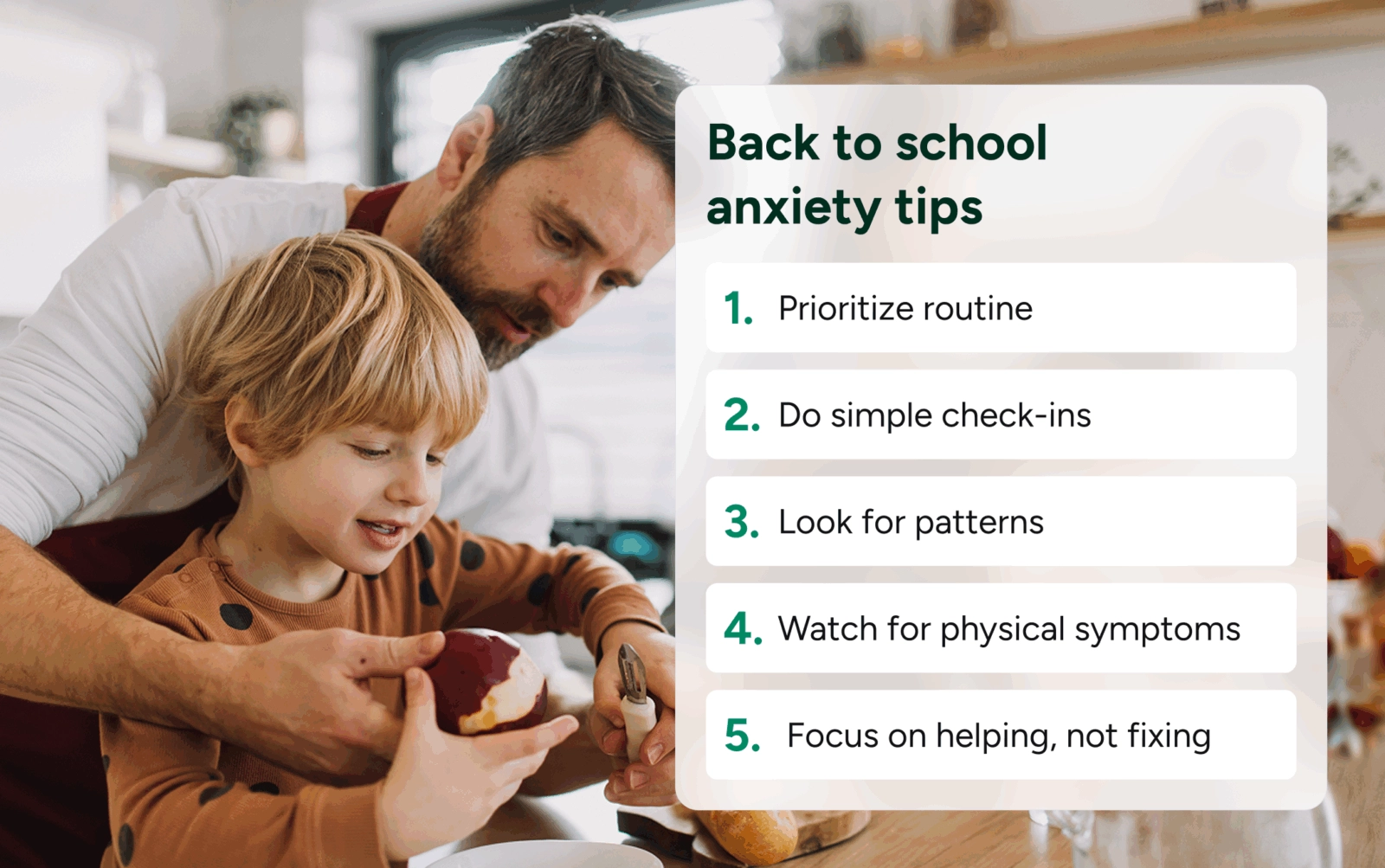
Back-to-school anxiety often responds best to steady support at home first, especially when you focus on the routines, patterns, and reassurance that help your child feel more secure as the school year begins. These tips are especially helpful when a child is still in the adjustment stage of going back to school.
1. Start with routine and predictability
A lot of school anxiety gets worse when the day feels uncertain. Predictability helps reduce that.
That might mean:
- Moving bedtime and wake time earlier gradually
- Doing a few practice mornings before school starts
- Talking through what the day will look like
- Keeping the first week as steady as possible where you can
- Making breakfast, drop-off, and after-school routines feel familiar
If you’re also working through sleep, physicals, meds, and other back-to-school prep, your back-to-school health checklist can help you think through the broader picture.
2. Keep check-ins calm and simple
Some kids want to talk a lot, but others don’t. Either way, it helps when they feel like they don’t have to explain everything perfectly.
You can try:
- Naming what you notice
- Asking one or two calm questions instead of many
- Validating that transitions can feel hard
- Avoiding the urge to over-reassure or over-analyze right away
Simple can work better than intense. “You seem a little more worried than usual. Want to tell me about that?” is often more helpful than a long conversation they may not feel ready for.
3. Look for patterns, not one hard day
One bad bedtime or one tearful school morning doesn’t always tell you much. Patterns are more useful.
Make sure to note:
- When the anxiety seems strongest
- Whether it’s tied to mornings, nights, school subjects, social situations, or transitions
- Whether physical complaints show up mostly before school
- What happens once your child is actually at school
- Whether things are getting better, staying the same, or getting worse
Patterns can help you tell the difference between expected adjustment and something that may need more support.
4. Watch for physical symptoms, too
Anxiety in kids doesn’t always appear as adults may expect. As Dr. Knox points out, “Kids will exert physical symptoms when they are stressed or have mental health issues.” He specifically calls out headaches and stomachaches as common examples.
That means school anxiety symptoms may not always look emotional first. They may look like:
- Repeated stomachaches before school
- Headaches that flare up at certain times
- Nausea
- Fatigue
- Trouble sleeping
- Appetite changes
That doesn’t mean every physical symptom is anxiety. But if the symptoms are showing up due to school-related stress, keep repeating, or don’t fit your child’s usual pattern, they’re worth paying attention to.
5. Focus on helping, not fixing everything at once
One of the most helpful ways to deal with school anxiety is to stop treating it like something that needs to be completely solved right away.
Instead, think in smaller steps:
- Make mornings easier
- Improve sleep
- Reduce uncertainty
- Support emotional regulation
- Notice what helps
- Look for changes over time
That approach can make the situation feel more manageable for both you and your child.

How to calm back-to-school anxiety
Once you have that broader support in place, there are also smaller, more immediate ways you can help lower your child’s anxiety in the moment and make the transition back to school feel less overwhelming.
Remember, the goal usually isn’t to make all anxiety disappear. It’s to lower the intensity enough that your child can cope, function, and move through the transition with more support.
A few things that can help:
- Make the unfamiliar more familiar. Review the school routine, talk through the day, visit the building if possible, or preview what’s changing.
- Use calm repetition. Kids often need to hear the same supportive message more than once.
- Keep your own energy steady. Children take in a lot from the tone around them, not just the words.
- Build in more margin where you can. Earlier bedtimes, less rushed mornings, and fewer extra stressors can all help.
- Support regulation before big transitions. Quiet time, movement, connection, and predictable rituals can all make school-related stress feel smaller.
Calming back-to-school anxiety can look different depending on the child. The point isn’t finding the perfect script — it’s helping your child feel safer, steadier, and less overwhelmed by the transition.

When school anxiety may be more than a rough transition
Some adjustment is expected. The question is whether your child’s anxiety is easing with support — or starting to interfere with daily life.
Dr. Knox shares that where parents should pay close attention lies in the functional aspect of it. In other words, how much is this affecting your child’s ability to sleep, participate, focus, cope, and function? Here are a few ways to assess whether your child’s school anxiety could be more than just a reaction to the transition.
It’s affecting sleep, appetite, or energy
If your child is having trouble sleeping, waking up exhausted, not eating normally, or dragging through the day, that’s worth noticing. A stressful week can do that temporarily, but a pattern that keeps going deserves a closer look.
Your child has repeated physical complaints before school
Look for symptoms that aren’t a one-time occurrence. “Something mild that’s not interfering with life is one thing, but when a child has a stomachache or headache that keeps them from school or activities, that should raise an eyebrow,” Dr. Knox advises.
That’s a very useful threshold when assessing your child’s anxiety. Physical symptoms that keep interfering with daily life may be telling you something important.
They’re avoiding school, activities, or social situations
Avoidance is one of the clearest signs that school anxiety may need more attention. That could look like:
- Trying to stay home
- Resisting routines more and more
- Refusing activities
- Not wanting to see friends
- Pulling back from things they normally enjoy
Their mood or behavior feels noticeably different
Sometimes school anxiety in kids looks like more irritability, bigger emotional reactions, more shut-down behavior, or less resilience than usual. If your child just doesn’t seem like themselves, trust that observation.
It’s getting worse instead of better
Typical back-to-school nerves usually settle as the routine becomes more familiar. If the distress is building instead of easing, that’s a sign to look more closely.
You keep feeling like something is off
Parents and caregivers often notice a shift before they can fully explain it — an intuitive feeling you can’t quite shake. That counts, and you should trust it. No one knows your child like you do, and you don’t need a perfect explanation before taking the next step.

When to start with primary care
If you’ve decided it’s time to take action but you’re not sure whether what you’re seeing is medical, emotional, or both, starting with primary care can be a strong first step.
This may make sense if your child is having:
- Headaches
- Stomachaches
- Appetite changes
- Trouble sleeping
- Fatigue
- Mixed physical and emotional symptoms
- General wellness concerns
- Recurring questions about whether something is normal
“Primary care is a great place to start if you’re concerned about mood symptoms in particular,” Dr. Knox shares. He also notes that primary care providers are often well equipped to address common concerns, including mild anxiety and related symptoms.

When behavioral health support may help
Behavioral health support, such as working with a therapist, may make more sense when anxiety is clearly affecting how your child copes, functions, or participates in daily life.
That may look like:
- Ongoing school dread
- Repeated avoidance
- Emotional overwhelm
- Withdrawal from friends or activities
- Persistent worries
- Mood or behavior changes that don’t seem to ease
- Physical symptoms that seem closely tied to anxiety
- Trouble functioning at home or school
This doesn’t have to mean crisis. It can simply mean your child is having a harder time than can be explained by a normal transition alone.
And, remember, it’s okay to act before things feel severe. Early support can help when school anxiety is starting to shape more of your child’s day than you want it to.

What to do when you’re still unsure
This is where many families get stuck.
You may know something doesn’t feel right, but still wonder:
- Is this school stress or something more?
- Should we start with primary care?
- Does this sound more like behavioral health?
- Do we need help finding the right provider?
- Are we overreacting, or waiting too long?
You don’t have to sort all of that out on your own.
If you’re not sure what kind of support your child needs, start with guidance from Included Health. You can discuss your situation with a Care Team member to understand what’s available to you, including possible next steps or provider options that can save time and make the path forward feel a lot clearer.
That can be especially helpful when:
- Symptoms don’t fit neatly into one category
- You’re juggling more than one concern
- You need help finding the right provider
- You want support that fits your child and your family’s reality
Sometimes the best first step is getting help with the second one.

When school anxiety may need more urgent attention
Most back-to-school anxiety does not need urgent intervention. But sometimes symptoms go beyond a routine transition concern.
More urgent attention may be needed if your child is:
- In extreme distress
- Unable to function day to day
- Rapidly getting worse
- Unable to attend school or participate in daily life
- Talking about self-harm or not wanting to be here
- Showing signs that make you concerned for their immediate safety
If that’s happening, it’s no longer just a question of how to deal with school anxiety at home. That calls for more immediate support, such as urgent care. You can also talk with a nurse if you need guidance on what would be the next best step for you.

Taking the next step
If you’re trying to figure out what to do next, this may help:
- Try at home first: routine, predictability, sleep reset, calm check-ins, and watching for patterns
- Start with primary care: physical symptoms, mixed concerns, sleep/appetite issues, or general wellness questions
- Consider behavioral health support: ongoing anxiety, avoidance, mood or behavior changes, daily-life impact
- Start with guidance: when you’re not sure what kind of support fits
Remember, back-to-school anxiety is common, but that doesn’t mean you have to ignore it and hope it passes on its own.
If your child seems more worried, more withdrawn, more physically stressed, or more unlike themselves than usual, it’s okay to take a closer look. You don’t need to wait until things feel severe to get support, and you don’t need to figure everything out before taking the next step.
If you’re unsure what matters most, where to start, or what kind of support fits, support is available.
Contact the Care Team if you’d like help thinking through your child’s next step.

Quan Lam is a copywriter with over 15 years of experience writing and editing content for both start-ups and legacy brands, as well as 2 years of writing experience exclusively within the healthcare space. She currently lives and works in New York City.

Dr. Brian Knox is board-certified in Internal Medicine and Pediatrics, and has been overseeing clinical services at Included Health for the past 3 years. Prior to joining IH 6 years ago, Dr. Knox spent 9+ years providing primary care to adults and children.